Last year, a project manager working on a road infrastructure project in northern Italy asked us: “Can’t we just put up a couple of CCTV cameras and call it done?“ It’s a fair question. CCTV is cheap, familiar, and easy to install. But after we explained what his slope actually needed — and what a CCTV system would silently miss — he changed his mind fast. This article is that same conversation, written down.
One more thing on lenses. With a standard CCTV camera, if you need to change the zoom or refocus on a different part of a slope, someone has to physically climb up and do it. Our devices have remotely adjustable varifocal lenses — you change the focal length from a browser, sitting at your desk. For a site at 2,000 meters elevation in winter, that difference alone is worth a lot.
3. Data Storage & Cloud Access
CCTV systems record everything to a local DVR or NVR. When storage fills up, older footage gets deleted automatically. That’s a reasonable design for security — you rarely need footage from three years ago to catch a break-in. But for geological monitoring, old data isn’t worthless. It’s often the most important data you have.
Think about it this way. A geologist investigating a new tension crack on a slope needs to know: when did this movement start? Was there a precursor pattern? How fast is it progressing? All of those answers live in historical imagery. If that imagery was overwritten six months ago by a CCTV loop, the investigation starts blind.
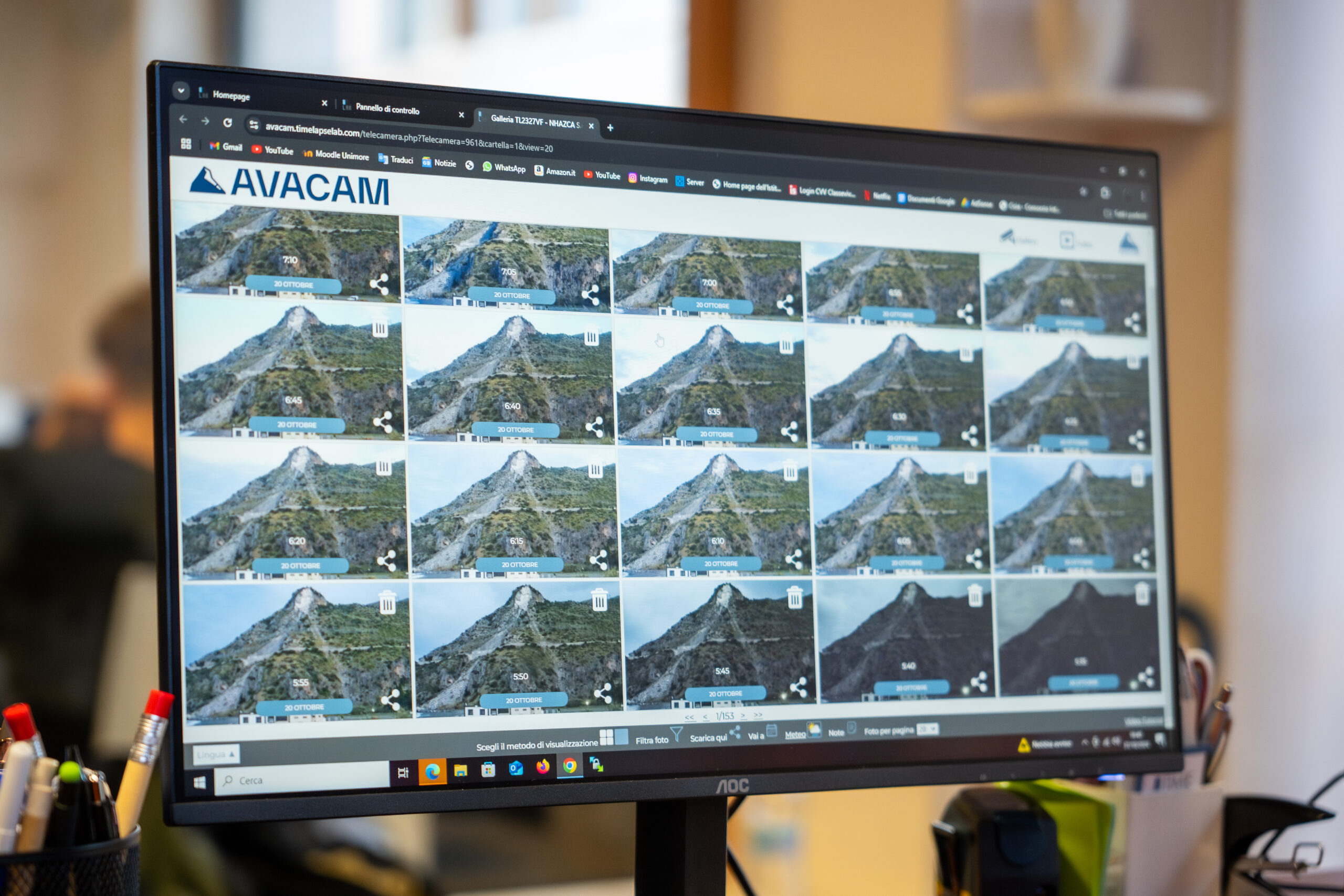
Every image captured by an Avacam device goes to a permanent cloud archive . Nothing gets deleted. The web dashboard lets you pull up any image from any date, compare two periods side by side, or generate a time-lapse showing years of evolution — from any device, anywhere, with no software to install. We’ve had clients access footage from three years ago to support an insurance claim. With CCTV, that conversation ends quickly.
4. Weather & Field Durability
We’ve installed devices in the Alps at 2,600 metres. In Scandinavian winters. On dam faces exposed to constant moisture and temperature swings. We know what “harsh environment” actually means — and most commercial CCTV hardware is not built for it.
A typical outdoor CCTV enclosure is rated IP65. That means it handles rain and dust reasonably well. What it doesn’t handle well is extended operation at −20°C, repeated freeze-thaw cycles that stress seals and circuit boards, or months of operation with zero maintenance access. One bad winter and you’re replacing hardware.
Our GEO devices are rated IP67/IP68 — fully waterproof and dustproof at depth — and tested to operate continuously from −20°C to +50°C . We test them because we deploy them in exactly those conditions. The enclosures are designed to take heavy snow loading, direct UV, and the kind of temperature swings that crack cheaper housings over time.
5. AI & Analysis Capabilities
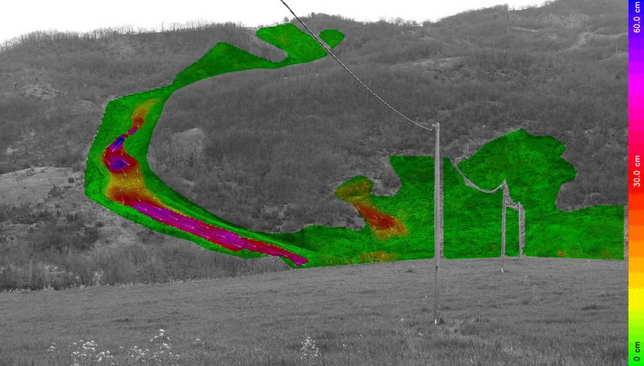
The AI built into CCTV systems is trained to detect people and vehicles moving in a frame. That’s genuinely useful for security. It’s completely useless for geological monitoring — because the terrain itself doesn’t “move” in a way that motion detection registers. A 5 mm slope displacement over three weeks looks like absolutely nothing to a CCTV motion algorithm. Zero alerts. Zero flags. You’d never know.
Our AI is different because it was built from the ground up for geotechnical analysis. It compares images across time, identifies subtle changes in terrain geometry, tracks displacement patterns, and sends alerts when movement rates exceed the thresholds your team defines. The GEO T8 Edge Computing model does this on-device — so even if connectivity drops, the analysis keeps running.
We also built the platform to work alongside other sensors, not replace them. Inclinometers, piezometers, weather stations — all of this data can be pulled into the same dashboard via API. A visual time-lapse of a slope moving combined with piezometer readings showing rising groundwater pressure? That’s the kind of multi-layer picture that actually supports a risk decision. No CCTV system gets you there.
6. Real Cost Over Time
CCTV looks cheap on paper. And honestly, for the hardware alone, it often is. But the total cost of a monitoring deployment isn’t just the purchase price — it’s everything that follows.
How often does someone need to visit the site to recalibrate, swap storage, or fix a failed component? What’s the cost of a missed event because the system wasn’t capturing what it needed to? What happens when a slope accident triggers a legal dispute and the footage needed to reconstruct the timeline was overwritten months ago?
Our devices are designed to need almost no hands-on attention after installation. Configuration changes happen remotely. Alerts go out automatically. Solar models run without any power infrastructure. And when something does need attention, the dashboard tells you what and where — no guesswork, no unnecessary call-outs. Over a three-to-five year deployment, that changes the cost comparison significantly.
7. Side-by-Side Comparison
| Feature | Traditional CCTV | Avacam Timelapse Monitoring |
|---|---|---|
| Primary Purpose | Security & access surveillance | Geological & structural change detection Purpose-built |
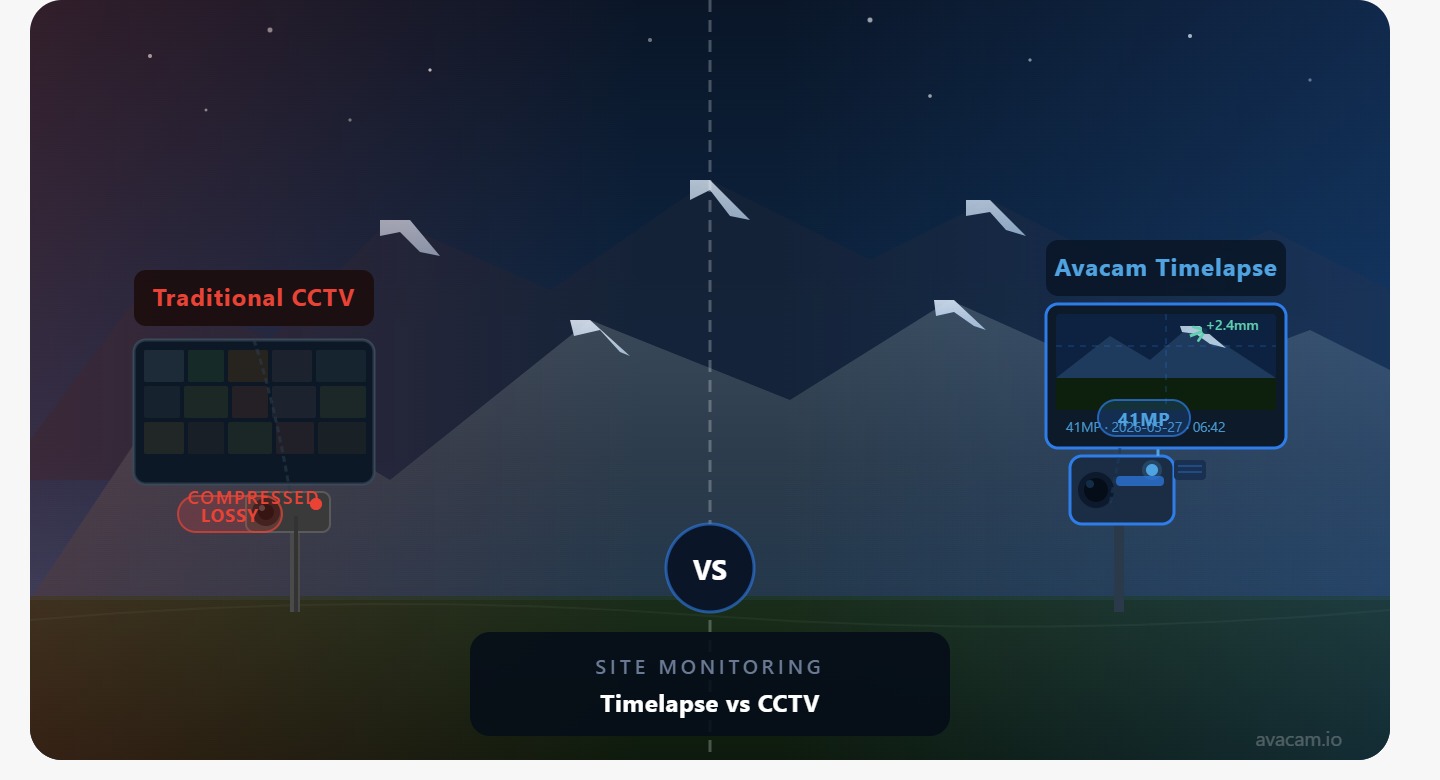
| Image Quality | Compressed video frames Lossy | Full-resolution stills up to 41MP Lossless |
| Lens Control | Fixed — requires on-site visit Manual | Remote varifocal adjustment Remote |
| Data Storage | Local DVR/NVR, circular overwrite Limited | Permanent cloud archive, full history Unlimited |
| Field Durability | Typically IP65, limited temp range Urban grade | IP67/68, −20°C to +50°C tested Industrial |
| Power Source | Mains electricity required Grid-dependent | Mains or solar — fully off-grid capable Autonomous |
| Connectivity | Wired LAN/internet required Wired only | 4G/LTE/LTE-M or Starlink satellite Anywhere |
| AI Capabilities | Motion/person/vehicle detection Generic | Geological change detection, displacement analysis Specialized |
| Sensor Integration | Standalone only Isolated | API integration with inclinometers, piezometers Interoperable |
| Privacy Compliance | Manual configuration Basic | Automatic GDPR masking built-in GDPR-ready |
| Remote Management | Requires on-site visits On-site | 100% remotely managed via Fully remote dashboard |
| Setup Complexity | Requires installation team, cabling complex | Plug and play, optimized remotely Simple |
8. When to Use Which System
We’re not here to say CCTV is bad. It isn’t. It’s just not the right tool for geological monitoring — the same way a torque wrench isn’t the right tool for cutting pipe. Both technologies have a clear place on a well-run project.
✓ CCTV Makes Sense For:
- Security at site entrances and access points
- Intruder detection and incident recording
- Tracking vehicles and personnel on active sites
- Indoor or sheltered monitoring environments
- Integration with alarm and access control systems
✓ Avacam Timelapse Makes Sense For:
- Landslide, rockfall, and slope movement monitoring
- Glacier retreat and ice mass tracking
- Flood and river level change monitoring
- Long-term structural deformation on dams, bridges, cuttings
- Remote or off-grid high-altitude deployments
- Geotechnical evidence for risk reports and legal defense
- GDPR-compliant monitoring in public or urban areas
On Complex Projects
For big infrastructure projects — motorway cuttings, railway embankments, dam faces, urban construction near unstable ground — the best answer is usually both systems running in parallel . CCTV handles site security. Avacam handles the geology. They don’t compete; they cover different blind spots.
9. Our Honest Take
If someone tells you a CCTV camera is good enough for landslide or glacier monitoring, they either haven’t thought through what monitoring actually requires, or they’re trying to save budget in the wrong place. CCTV is a solid, well-understood security technology — but it wasn’t designed for geology, and no amount of configuration changes that. If your site has a real geological risk, it deserves a system built to see what CCTV can’t. That’s what we built Avacam to do.
Want to See It in Action?
Talk to our team about your site — we’ll tell you honestly which device fits, and why. No pressure, no boilerplate proposals.