Most landslides rarely happen without warning. What happens more often is that the warnings are there a hairline crack, a slight tilt, a new wet patch, a 4mm displacement and nobody is watching closely enough or continuously enough to catch them in time.
In August 2025, a massive landslide sent 2.3 billion cubic feet of rock into a fjord in Alaska, triggering a wave that rose 1,580 feet above sea level. At first glance, scientists saw nothing unusual on the slope beforehand no surface cracks, no obvious scarring. But underground, seismic sensors had been picking up small, repeating earthquakes in the days before the collapse. The warning was there. Nobody was reading it. That’s the reality of landslide risk and it’s exactly why understanding the early warning signs, and having systems that detect them automatically, is not optional.
Before we get into the signs themselves, one important point. Landslides don’t all behave the same way. A slow-moving clay slide might show signs for weeks or months before failure. A rockfall on a steep granite face might give almost no visible warning at all. The signs below apply primarily to soil and debris landslides the most common type affecting roads, infrastructure, and populated areas. Keep that context in mind as you read.
Warning Sign 1 Most Critical
Tension Cracks at the Top of the Slope
This is the single most important warning sign engineers look for. Tension cracks also called crown cracks — appear at or near the top of a slope when the upper mass of soil begins to pull away from the stable ground above it. They form because the slope is already moving, even if only slightly, and the ground is being stretched at the crown.
What do they look like? A fresh tension crack is usually a straight or slightly curved gap in the ground surface, running roughly parallel to the slope crest. They can be as narrow as a few centimetres or as wide as 10–20 cm in advanced cases. They often run for several metres sometimes tens of metres across a slope face.
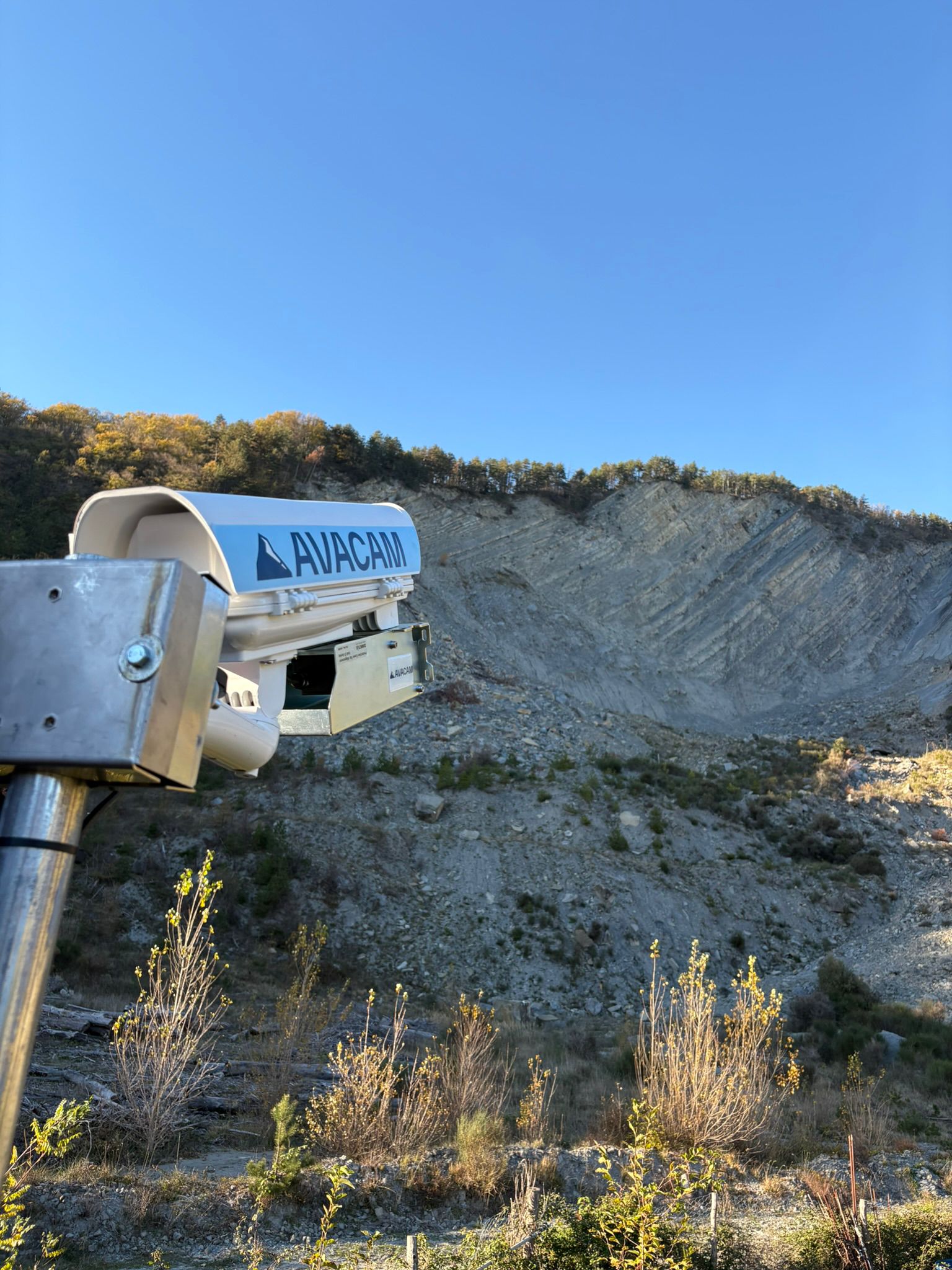
The problem is finding them. In a dense vegetation area, a tension crack can be completely hidden until it’s wide enough to trip over. In a bare rock face, it may be a barely visible hairline. This is exactly why the Avacam monitoring platform which captures high-resolution images at regular intervals and compares them against a baseline can flag a crack that has opened by just a few millimetres before any site inspector would notice it during a walk-past.
What to do: Any new tension crack on a monitored slope should be treated as a red flag immediately. Measure it, photograph it, record the date, and increase monitoring frequency. Do not assume it is superficial.
Warning Sign 2
Tilting Trees, Poles, and Fences
When the ground moves, everything attached to it moves too. Trees are one of the clearest visual indicators of slow, ongoing slope movement but you have to know what you’re looking for. A tree that has been growing on a slowly creeping slope will often develop a curved trunk — straight near the base where the roots anchor into moving soil, then bending upward as the upper trunk continues to grow vertically. Geologists call these “pistol-butt trees” or “sabre trees.” They’re a sign that the slope has been moving for years.
More immediate warning comes from recently tilted trees ones that were straight last season but are now leaning noticeably downslope. The same applies to fence posts, utility poles, retaining walls, and any other vertical structures on or near the slope. If a row of telephone poles along a hillside road are suddenly not standing straight, that’s not a maintenance problem. That’s a geology problem.
In our experience, tilting structures are often one of the first things a road patrol driver notices but only because the movement has already been going on for some time. A timelapse monitoring system would have flagged the early stages of that tilt weeks earlier.
Warning Sign 3
New Springs, Wet Spots, or Changes in Water Flow
Groundwater is the hidden engine of most landslides. When water pressure inside a slope rises whether from prolonged rainfall, snowmelt, or blocked drainage it reduces the friction between soil layers and pushes the slope toward failure. Changes in how water behaves on and around a slope are therefore one of the most reliable early warning indicators available.
Specifically, watch for: new springs or seeps appearing on a slope face that was previously dry; sudden increases in the flow from existing springs after a rainfall event; wet patches on a slope that don’t dry out between rain events; and changes in the clarity of spring water murky or sediment-laden water can indicate internal erosion of the slope.
This is a sign that is almost impossible to detect with a standard site inspection unless you happen to visit right after a significant rainfall event. A camera system that captures images throughout the day including during and after rainfall builds up a picture of how the slope’s drainage behaviour changes over time. That pattern data is genuinely valuable for understanding risk.
Research finding
Studies of rainfall-induced landslides consistently show that soil moisture at the crown of a slope becomes significantly elevated before failure — and crown cracks expand to allow more rainfall infiltration, accelerating the process. Monitoring moisture patterns visually over time reveals this progression clearly.
Warning Sign 4 Most Detectable by Technology
Subtle Ground Displacement Too Small to See
This is the warning sign that separates modern monitoring from traditional inspection. And it is, in our view, the most important one.
Most catastrophic slope failures are preceded by a period of slow, progressive displacement the slope creeping downward at rates that start in millimetres per week and accelerate over days or weeks before failure. In the case study we published earlier this year, the first displacement detected on a mountain road slope was just 4mm. Eleven days later, 850 cubic metres of material came down onto the road.
Four millimetres. That’s less than the thickness of a pencil. No site inspector walking past that slope would have noticed it. No CCTV camera would have flagged it. But a 20-megapixel timelapse camera comparing images against a precise baseline and running AI analysis to detect changes caught it immediately and triggered an alert.
The scientific literature is clear on this: displacement rate is the most reliable predictor of slope failure. A slope that was moving at 2mm per week and suddenly accelerates to 8mm per week is in a fundamentally different risk category. Catching that acceleration early is the difference between a planned road closure and an emergency response.
Critical point
Displacement that starts slow and then accelerates is the classic signature of impending failure. The acceleration phase not the initial movement is when the window for intervention is closing. If you don’t have a monitoring system that tracks displacement rate over time, you will always be reacting rather than preventing.
Warning Sign 5
Bulging at the Base of the Slope
While tension cracks appear at the top of a failing slope, the other end of the failure mechanism shows itself at the bottom. As the upper mass of a slope begins to move, material accumulates at the toe causing a visible bulge or swelling in the ground at the base of the slope.
On a road cutting, this might look like the embankment below the road appearing to push outward, or the road surface itself developing a bump or hump that wasn’t there before. On a natural slope, you might see a gentle swelling of the ground where the slope meets a flat area, or debris beginning to accumulate at the base without an obvious source above.
Bulging at the toe is often a later-stage sign it typically appears after significant movement has already occurred in the body of the slope. But in some slope geometries, particularly in clay-rich soils, it can appear relatively early. Either way, it demands immediate attention and assessment.
Warning Sign 6
Cracking in Buildings, Roads, and Drainage Systems
Slope movement doesn’t stay on the slope. Any structure built on or adjacent to an unstable slope will show signs of that movement often long before the slope itself gives obvious visual cues. This is why a crack in a building foundation, a buckled section of road surface, or a drainage channel that has pulled apart at the joints deserves serious investigation if it’s on or near a slope.
Common structural signs include: doors and windows that suddenly stick or no longer close properly a sign that the building frame is distorting; cracks in exterior or interior walls that are widening over time; road surfaces that develop transverse cracks running across the carriageway; kerbs and drainage channels that show separation or offset at joints; and retaining walls that are leaning forward or developing horizontal cracks near the base.
The key word in all of these is “widening” or “new.” Buildings crack. Roads develop defects. The concern is new cracking that wasn’t there before, or existing cracks that are getting worse. If you can mark a crack with chalk and come back a week later to find it has opened further that slope needs professional assessment urgently.
Warning Sign 7 Act Immediately
Unusual Sounds From the Slope
This one is at the end of the list but it should be at the front of your mind when you are physically near a slope. Unusual sounds cracking, popping, rumbling, or the sound of water where no surface water is visible are a sign that something is happening inside the slope right now.
The cracking and popping sounds come from rock and soil fracturing under stress. The rumbling can indicate internal water movement or the early stages of debris mobilisation. Research following the 2025 Alaska landslide identified small, repeating seismic tremors in the days before the collapse described by scientists as “tiny bits of slip on the base of the landslide sounds too subtle to hear but detectable by sensors.
If you or your team hear sounds coming from a slope — leave the area immediately. Do not investigate. Do not wait to see what happens. Sounds from a slope are a last-stage warning that failure may be imminent, not a first-stage observation to note down and monitor.
Immediate action required
Audible sounds from a slope cracking, rumbling, or unusual water noise mean evacuate now. This is not a monitoring situation. This is an emergency response situation. Clear the area and contact the relevant civil protection authority immediately.
Why These Signs Get Missed Even By Professionals
Reading this list, you might think: these sound obvious. If a tree is tilting and there’s a crack in the road, surely someone would notice. The reality is more complicated than that.
Most of these signs develop slowly. A tension crack that opens 2mm a week looks like nothing for the first month. A tree that tilts 0.5 degrees a season looks perfectly normal until you have a photograph from three years ago to compare it against. Groundwater changes only show up during and after rain events — which is exactly when nobody wants to be walking the slope face for an inspection.
Annual visual inspections — still the default approach on most monitored slopes across Europe — are structurally incapable of catching early-stage warning signs. They capture one day out of 365. Everything that happens on the other 364 days is invisible to the inspection record.
“The problem is not that slopes don’t give warnings. Most of them do. The problem is that nobody is watching continuously enough to see them.”
— Avacam Engineering TeamThis is precisely what continuous visual monitoring addresses. A timelapse camera capturing images every 30 minutes, comparing each one to a precise baseline, and running AI analysis to flag anomalies that system is watching the slope on all 365 days, in all weather conditions, at all hours. An annual inspection is not.
What AI Catches That Human Eyes Miss
Avacam’s systems which run on NVIDIA’s AI infrastructure fo llowing our inclusion in the NVIDIA Inception Program — are specifically trained to detect geological change patterns in timelapse imagery. This is a fundamentally different task from standard computer vision or security camera AI, which is trained to detect moving objects in a frame.
Geological AI looks at two images taken days or weeks apart and identifies where pixels have shifted, where new features have appeared, and where existing features have changed shape or position. At 20 megapixels resolution, that analysis can detect a 4mm surface displacement on a rock face at 150 metres distance. No human eye can do that reliably across an entire slope face over an extended period.
Signs 1, 2, 3, 4, and 5 in this article are all detectable by continuous high-resolution timelapse monitoring before they would be visible to a site inspector during a routine walk-past. Sign 6 is detectable on structures within the camera’s field of view. Sign 7 requires physical presence and by that point, you should be leaving, not observing.
Site Inspection Checklist: 7 Things to Look For
The Bottom Line
Landslides rarely happen without warning. What happens more often is that the warnings are there a hairline crack, a slight tilt, a new wet patch, a 4mm displacement and nobody is watching closely enough or continuously enough to catch them in time. The gap between “warning exists” and “warning detected” is where disasters happen. Continuous monitoring closes that gap. It doesn’t stop geology from doing what geology does. But it gives the people responsible enough time to respond and in most cases, that’s all you need.
Is Your Slope Being Watched?
If you manage a road, a construction site, or any infrastructure near an unstable slope. talk to us. We’ll tell you exactly what monitoring you need and why.